Learning English can feel confusing at times, especially when you hear terms like nouns, verbs, or adjectives. You might wonder what they really mean or how to use them correctly in your sentences. If you’ve ever paused while writing or speaking, unsure about word roles, you’re not alone 🙂
Imagine a student writing: “She quickly runs beautifully.” It sounds odd, right? The words are correct, but the usage is not. This happens when you don’t fully understand parts of speech. Small mistakes like this can change meaning and clarity.
Did you know? Every English sentence is built using just a few basic parts of speech. Once you understand them, your speaking and writing become much clearer and more natural.
So, if you want to improve your grammar, this guide will help you step by step. You’ll learn simple rules, real examples, and how to use parts of speech correctly in everyday sentences.
Clear Explanation
Let’s make this super simple.
Parts of speech are the building blocks of English. Every word you use belongs to a category. These categories help you form clear and correct sentences.
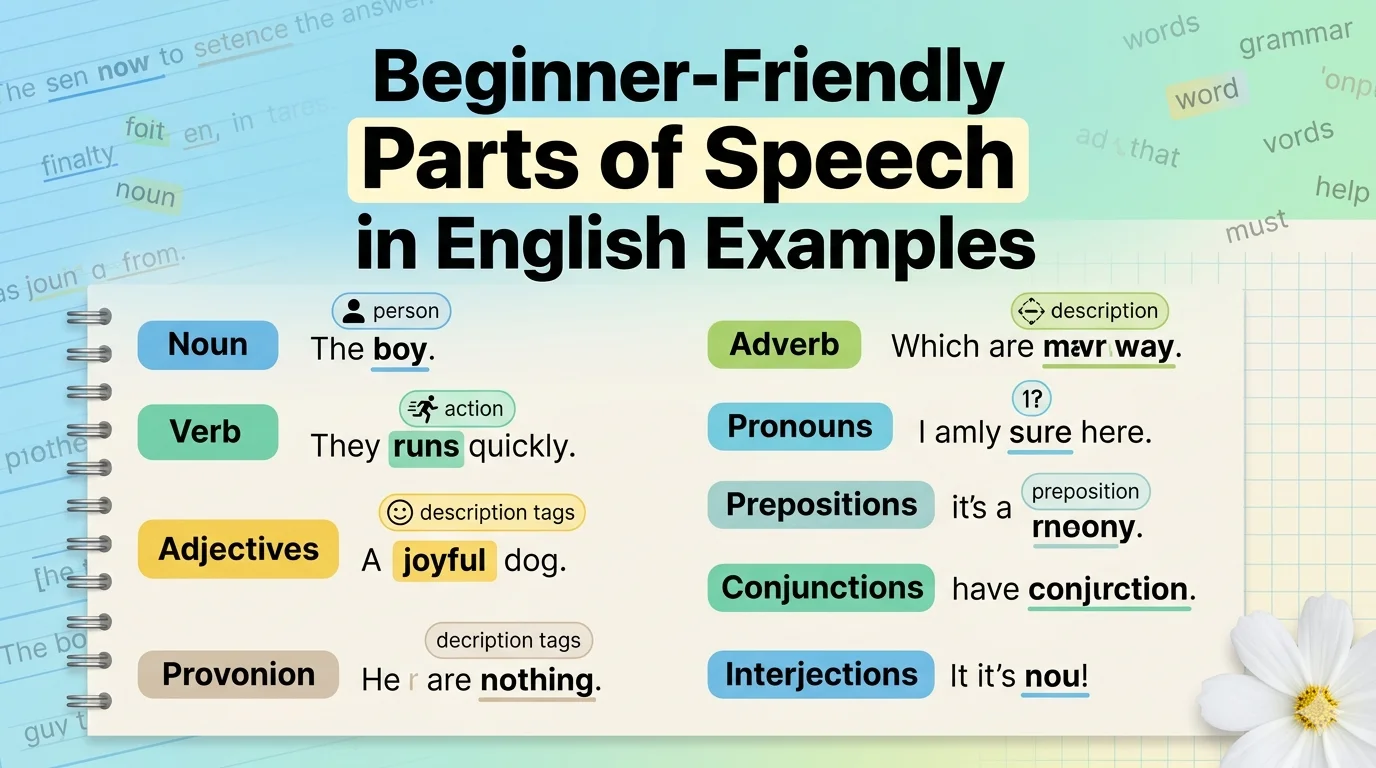
Here are the main parts of speech:
- Noun – names a person, place, or thing
- Verb – shows action or state
- Adjective – describes a noun
- Adverb – describes a verb
- Pronoun – replaces a noun
- Preposition – shows position or direction
- Conjunction – joins words or sentences
- Interjection – shows emotion
Quick tip you’ll love:
If you know what each word does, your sentences become stronger and clearer.
Examples in Sentences
- She runs every morning. (Verb)
- The cat is sleeping. (Noun)
- He is a smart student. (Adjective)
- They worked quickly. (Adverb)
- Wow! That’s amazing. (Interjection)
Common Mistakes
Here’s where most people get confused.
❌ Incorrect: She very runs fast
✅ Correct: She runs very fast
❌ Incorrect: He is a quickly boy
✅ Correct: He is a quick boy
❌ Incorrect: They happy are
✅ Correct: They are happy
❌ Incorrect: I went in home
✅ Correct: I went home
❌ Incorrect: She is more smarter
✅ Correct: She is smarter
Practice Exercises
Try this yourself:
- Identify the noun: She has a red car.
- Fill in the blank: He ___ (run/runs) fast.
- Choose the correct word: She is (happy/happily).
- Fill in the blank: The dog barked ___. (loud/loudly)
- Identify the verb: They play football.
- Choose the correct option: He is a (quick/quickly) learner.
- Fill in the blank: I saw ___ elephant. (a/an)
- Identify the adjective: It is a blue sky.
- Choose: She sings (beautiful/beautifully).
- Fill in the blank: Wow! That was ___. (amazing/amazed)
Real-Life Parts of Speech Examples in Sentences
Clear Explanation
Now let’s see how parts of speech work in real life.
You don’t learn grammar just by rules. You learn it by seeing how words work in sentences.
Each word plays a role. When you understand that role, your English becomes natural.
For example:
- “She runs fast.” → Simple and clear
- “The happy child laughed loudly.” → More descriptive
Quick tip:
Always look at how words connect. That’s the secret to strong sentences.
Examples in Sentences
- The boy kicked the ball. (Noun + Verb)
- She wore a beautiful dress. (Adjective)
- He spoke softly. (Adverb)
- They are playing outside. (Pronoun)
- The book is on the table. (Preposition)
Common Mistakes
❌ Incorrect: She is speak English
✅ Correct: She speaks English
❌ Incorrect: He run very fast
✅ Correct: He runs very fast
❌ Incorrect: The flower is very beautifully
✅ Correct: The flower is very beautiful
❌ Incorrect: Me and him went there
✅ Correct: He and I went there
❌ Incorrect: She is in the home
✅ Correct: She is at home
Practice Exercises
Try this yourself:
- Identify the verb: She sings well.
- Fill in the blank: The cat is ___ the table. (on/in)
- Choose: He runs (quick/quickly).
- Identify the pronoun: They are happy.
- Fill in the blank: She is a ___ girl. (kind/kindly)
- Choose: I saw (he/him) yesterday.
- Identify the adjective: It’s a cold day.
- Fill in the blank: He spoke ___. (soft/softly)
- Choose: This is (my/mine) book.
- Identify the preposition: The keys are under the chair.
Common Mistakes in Parts of Speech Usage Explained
Clear Explanation
Here’s where many learners struggle.
Parts of speech mistakes happen when you use the wrong type of word in a sentence. It may look small, but it changes meaning and grammar accuracy.
Most errors come from:
- Confusing adverbs and adjectives
- Wrong verb forms
- Incorrect pronoun usage
- Mixing sentence structure
- Missing prepositions
Quick tip:
Always check what job the word is doing in the sentence.
Examples in Sentences
- He runs quickly every day.
- She is a good singer.
- They are playing football.
- I went to the market.
- She gave him a gift.
Common Mistakes
Let’s fix real learner errors.
❌ Incorrect: She speak very good English
✅ Correct: She speaks very good English
❌ Incorrect: He is a fastly runner
✅ Correct: He is a fast runner
❌ Incorrect: They is happy
✅ Correct: They are happy
❌ Incorrect: I am agree with you
✅ Correct: I agree with you
❌ Incorrect: She goes to home
✅ Correct: She goes home
Practice Exercises
Try this yourself:
- Choose correct: She (speak/speaks) English well.
- Fill in the blank: He is a ___ boy. (good/well)
- Correct sentence: They is playing football.
- Fill in the blank: I agree ___ you. (with/to)
- Choose correct: She runs (quick/quickly).
- Fix sentence: He are my friend.
- Fill in the blank: She went ___ school. (to/in)
- Choose correct: They (is/are) happy.
- Fix sentence: He is very fastly.
- Identify mistake: She sing good.
When and Where to Use Parts of Speech Properly
Clear Explanation
Now let’s understand usage.
You don’t just memorize parts of speech. You use them in real communication.
Each situation needs a different word type:
- Talking about things → nouns
- Describing actions → verbs
- Adding detail → adjectives and adverbs
- Connecting ideas → conjunctions
Quick tip:
Think of parts of speech like tools in a toolbox.
Examples in Sentences
- She is a doctor.
- He works hard every day.
- It is a cold night.
- They are running fast.
- I like tea and coffee.
Common Mistakes
❌ Incorrect: She is doctor
✅ Correct: She is a doctor
❌ Incorrect: He work hard
✅ Correct: He works hard
❌ Incorrect: It is coldly night
✅ Correct: It is a cold night
❌ Incorrect: They runs fast
✅ Correct: They run fast
❌ Incorrect: I like tea but coffee
✅ Correct: I like tea and coffee
Practice Exercises
Try this yourself:
- Fill in: She is ___ engineer. (a/an)
- Choose correct: He (work/works) daily.
- Identify noun: They play cricket.
- Fill blank: It is a ___ day. (hot/hotly)
- Choose: I like tea (and/but) coffee.
- Fix sentence: She doctor is.
- Fill blank: He runs ___. (fast/fastly)
- Choose correct: They (is/are) students.
- Identify verb: The dog barked loudly.
- Fill blank: She is ___ teacher. (a/an)
You’re getting stronger with every practice step 🙂
Quick Tips to Improve Parts of Speech Usage
Clear Explanation
Let’s make improvement easy.
You don’t need to memorize everything. You need smart habits.
Here are simple ways to improve:
- Read simple English daily
- Notice word roles in sentences
- Practice writing short sentences
- Learn from mistakes
- Speak regularly
Quick tip:
Small daily practice beats long study sessions.
Examples in Sentences
- The sun shines brightly.
- She is a happy child.
- He plays football.
- They are very kind.
- I enjoy reading books.
Common Mistakes
❌ Incorrect: She very happy
✅ Correct: She is very happy
❌ Incorrect: He plays good
✅ Correct: He plays well
❌ Incorrect: They is nice
✅ Correct: They are nice
❌ Incorrect: I like book reading
✅ Correct: I like reading books
❌ Incorrect: She runs very fastly
✅ Correct: She runs very fast
Practice Exercises
Try this yourself:
- Fill blank: She is ___ happy girl. (a/very)
- Choose: He plays (good/well).
- Fix sentence: They is kind.
- Identify word: She sings beautifully.
- Fill blank: I like ___ books. (read/reading)
- Choose correct: She is (very/too) smart.
- Fix sentence: He runs fastly.
- Identify noun: The dog is barking.
- Fill blank: They are ___ students. (good/goodly)
- Choose: She speaks English (fluently/fluent).
Quick Summary Table
| Part of Speech | Function | Example |
| Noun | Names things | book, city |
| Verb | Shows action | run, eat |
| Adjective | Describes noun | big, small |
| Adverb | Describes verb | quickly |
| Pronoun | Replaces noun | he, she |
| Preposition | Shows position | in, on |
| Conjunction | Joins ideas | and, but |
| Interjection | Shows emotion | wow! |
Conclusion
Understanding parts of speech in English is the first big step toward mastering grammar. Once you know how nouns, verbs, adjectives, adverbs, and other word types work, you can build clear and meaningful sentences with confidence. It removes confusion and helps you express your thoughts more naturally. Instead of guessing, you start recognizing patterns in real communication.
Whether you are speaking, writing, or reading, parts of speech guide every sentence you use. With regular practice and simple examples, you will notice big improvements in your English skills. Keep learning, keep practicing, and focus on real-world use rather than memorizing rules. Over time, grammar will feel easier and more automatic. Stay consistent, and your confidence in English will grow naturally every day.
FAQs
What are parts of speech in English?
Parts of speech are categories that show how words function in a sentence. They include nouns, verbs, adjectives, adverbs, pronouns, prepositions, conjunctions, and interjections. Each type has a specific role that helps form correct and meaningful sentences in English communication.
Why are parts of speech important in grammar?
Parts of speech are important because they form the foundation of English grammar. They help you understand sentence structure, improve writing clarity, and reduce mistakes. Without them, sentences become confusing and unclear. Learning them improves both spoken and written English skills effectively.
How many parts of speech are there in English?
There are eight main parts of speech in English. These include nouns, verbs, adjectives, adverbs, pronouns, prepositions, conjunctions, and interjections. Each category plays a unique role in sentence formation and helps you communicate ideas clearly and correctly in everyday English.
What is the easiest way to learn parts of speech?
The easiest way to learn parts of speech is through practice and examples. Read simple sentences daily and identify word roles. Writing your own sentences also helps. Avoid memorizing only rules. Instead, focus on real usage, which makes learning faster and more natural.
What is a noun in parts of speech?
A noun is a word that names a person, place, thing, or idea. Examples include book, city, and teacher. Nouns are important because they act as the main subjects or objects in sentences. They help you identify what or who the sentence is about clearly.
What is the role of verbs in sentences?
Verbs show action or a state of being in a sentence. Words like run, eat, and is are verbs. They are essential because they tell what the subject is doing. Without verbs, sentences are incomplete and cannot express a clear meaning in English communication.
What is the difference between an adjective and an adverb?
An adjective describes a noun, while an adverb describes a verb, adjective, or another adverb. For example, “beautiful flower” uses an adjective, while “runs quickly” uses an adverb. Understanding this difference helps you build more accurate and expressive English sentences.
Can one word belong to more than one part of speech?
Yes, one word can belong to different parts of speech depending on its use in a sentence. For example, “light” can be a noun or an adjective. The meaning changes based on context, which makes understanding sentence structure very important in English grammar.
What are common mistakes in parts of speech?
Common mistakes include mixing adjectives and adverbs, incorrect verb forms, and wrong sentence structure. For example, saying “she runs quickly” instead of “she runs quickly.” These errors happen when learners do not understand word functions clearly, but practice helps reduce them quickly.
How can I improve my parts of speech skills fast?
You can improve quickly by practicing daily reading and writing. Identify word types in sentences you read. Create your own examples and correct mistakes. Using simple English conversations also helps. Consistent practice makes understanding parts of speech easier and more natural over time.
