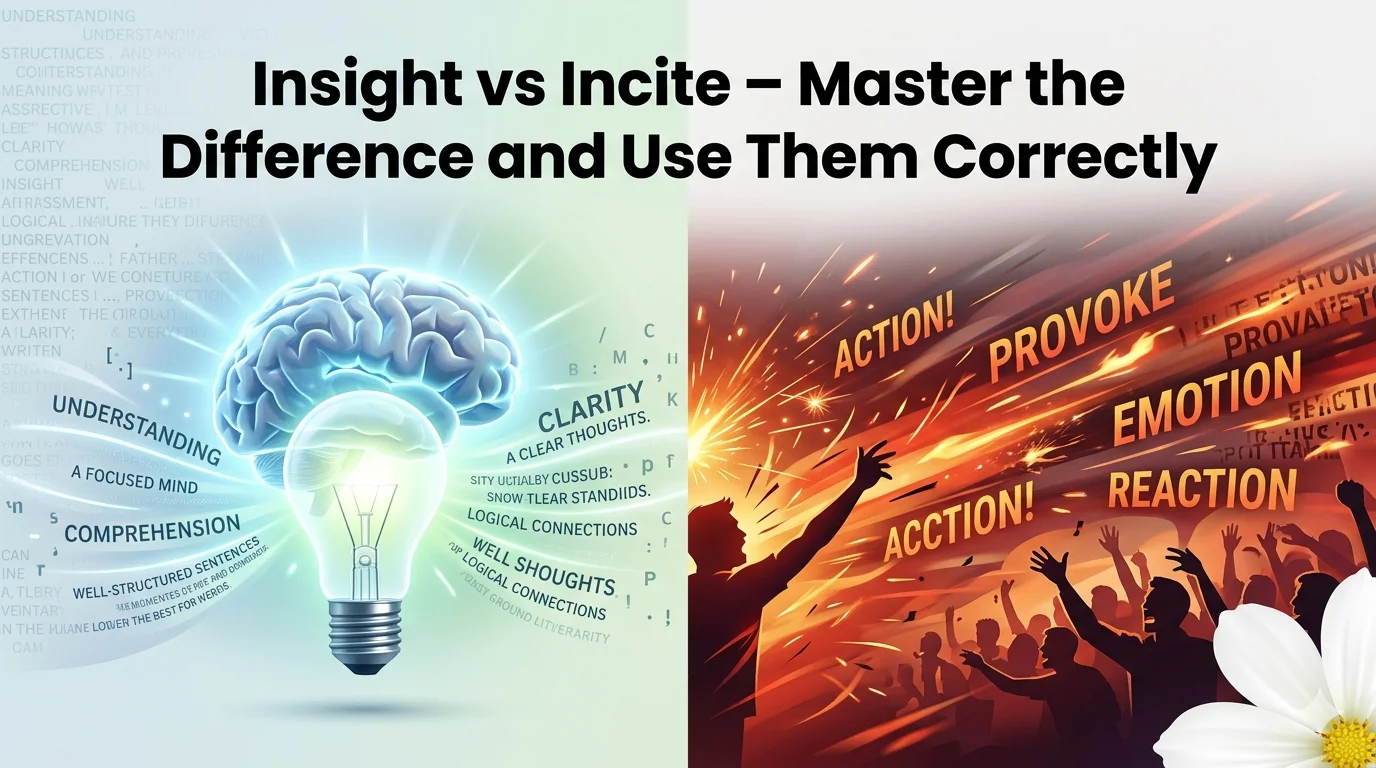
When learning English, Insight vs. Incite often confuses learners because the words look alike yet differ in meaning, creating a subtle twist in usage. Insight represents deep understanding and clarity, allowing one to recognize patterns, connections, and meanings beneath the surface. Incite, in contrast, is about provoking action or stirring emotions, intentionally encouraging responses like curiosity, debate, or excitement. The key distinction lies in intent: one word fosters reflection, while the other sparks movement. Recognizing this difference improves communication and helps avoid unintended surprises in expression.
Using insight effectively can enrich comprehension and analysis, making concepts clearer and lessons more meaningful. It allows you to grasp ideas fully and communicate with depth. Meanwhile, learning to incite properly gives your words impact, helping you motivate, influence, or stimulate discussions. The contrast emphasizes that language is not just about definitions but also about the effect your words have on others. Understanding when to reflect versus when to provoke is essential for precise and purposeful communication.
Mastering the difference between insight and incite strengthens both learning and everyday language use. By paying attention to subtle distinctions in meaning, grammar, and context, learners can reduce confusion and communicate more accurately. This nuanced understanding turns what may seem like tricky vocabulary into an enjoyable challenge, enhancing fluency and the ability to engage others thoughtfully. Even small surprises in usage become opportunities for skillful expression.
Why Getting “Insight” and “Incite” Right Matters
When you write, readers trust you. But that trust can wobble when word choices aren’t precise. Using insight vs incite incorrectly doesn’t just create awkwardness — it can alter what you intend to say.
Imagine telling a team meeting, “I want to incite you on what happened last quarter.” That sounds like you want to provoke them — maybe even stir trouble. What you likely mean is insight, a deep understanding of past trends.
Most people mix these up because English has borrowed words from many languages. But mix‑ups can make content look less professional. This article dismantles the confusion with clear explanations, examples, case studies, tables, memory hacks, and practical exercises.
By the end, you’ll use these words with precision — effortlessly and confidently.
What Do “Insight” and “Incite” Mean? Clear Definitions
Let’s get clear definitions out of the way first.
| Word | Part of Speech | Meaning | Example |
| Insight | noun | A deep understanding of a situation, person, or problem | “Her insight into consumer behavior improved sales by 25%.” |
| Incite | verb | To stir up action, often strong, sometimes violent or emotional | “The speech incited protests that spread nationwide.” |
Insight – Deep Understanding
Insight refers to the ability to see below the surface. It goes beyond facts and data — it reveals hidden patterns, meanings, or truths.
Think of insight as a lightbulb moment:
- You analyze.
- You reflect.
- You see what others miss.
For example:
“After reviewing the customer feedback, we gained insight into why churn was high — users felt onboarding was confusing.”
Here, people understood deeply something not obvious.
Incite – Spark Action
Incite, on the other hand, means to urge or provoke action. Often, that action is emotional, intense, or disruptive.
For example:
“His speech incited the crowd, leading to spontaneous demonstrations.”
Notice how incite often implies a triggering force.
Key difference in simple terms:
- Insight = understanding.
- Incite = provoke action.
Origins and Etymology – Where These Words Came From
Understanding where words come from helps lock in meaning.
Insight – Roots in Old Languages
Insight comes from a combination of two older elements:
- “in” (into)
- “sight” (vision or seeing)
It grew from Middle English and Old Germanic roots. The idea was simple — seeing inwardly, figuratively, to understand something fully.
Over time, that evolved into the modern meaning: deep intuition or understanding.
Incite – Latin Power Word
Incite comes from Latin incitāre, meaning “to urge on” or “to set in motion.”
Think of it as a linguistic gasoline can.
The word passed through Old French into English, keeping its sense of provoking or spurring action.
So etymology reflects difference:
- Insight = mental clarity, internal sight.
- Incite = external activation.
Pronunciation and Stress Patterns
Even if you spell the words correctly, pronunciation can help reinforce the difference.
| Word | IPA Pronunciation | Syllables | Pronunciation Tip |
| Insight | /ˈɪn.saɪt/ | 2 | Stress on first syllable; sounds like “IN‑sight” |
| Incite | /ɪnˈsaɪt/ | 2 | Stress on second syllable; sounds like “in‑SIGHT” |
Why Stress Matters
Most English speakers rely on stress patterns to differentiate similar words. In insight vs incite, moving the stress shifts meaning:
- INSIGHT → understanding
- inCITE → push to act
Here’s a mnemonic:
Insight shines in your mind.
Incite sits in action.
Say them aloud. Feel the stress shift? That’s your brain hard‑wiring the difference.
Correct Usage in Context
Here’s where theory meets practice. Let’s look at how each word fits different contexts.
Writing Contexts
Insight often appears in:
- Research reports
- Analyses
- Presentations
- Lessons learned segments
For example:
“Our data gave valuable insight into seasonal spending patterns.”
Incite appears where action is triggered:
- Debates
- Protests
- Emotional speeches
- Triggers for reactions
For example:
“The article incited strong responses from the community.”
In Business Writing
Use insight for strategy and thinking:
- “Sales insights reveal customer values.”
- “Her market insight helped redirect our campaign.”
Avoid using incite unless you mean to provoke or urge:
- “We don’t want to incite fear in our audience.”
(Note: This is a correct avoidance use of the word.)
In Academic Writing
Academics typically lean on insight:
- “This study provides insight into behavioral patterns.”
Using incite here would sound wrong unless discussing actions the research provokes.
Common Mistakes and Linguistic Pitfalls
Even experienced writers slip here. Let’s expose the most frequent traps.
Mistake #1 – Substituting One for the Other
Wrong:
“The CEO’s speech offered great incite into future plans.”
Why it’s wrong: The sentence is meant to describe understanding, not provoking action.
Correct:
“The CEO’s speech offered great insight into future plans.”
Mistake #2 – Thinking “Incite” Is Positive
Some assume incite simply means motivate. But legally and emotionally, it often implies provoking strong or negative responses.
For example:
“His post incited anger on social platforms.” (Negative drama)
So, use it carefully.
Mistake #3 – Mishearing Similar Words
Words like invite, ignite, insight, incite — they all rhyme slightly. Context and spelling matter more than sound here.
Tips for Remembering the Difference
Here are quick memory hacks to ensure you never confuse them.
Analogy: Light vs Spark
- Insight = light that helps you see the picture clearly.
- Incite = spark that makes things move or react.
A lightbulb vs a match — same energy, different purpose.
Visualization
Picture a thinker (lightbulb) for insight.
Picture a match flame for incite.
Word Families
Words that go with each:
- Insight: understanding, reflection, awareness, clarity
- Incite: provoke, stir, ignite, instigate
Flashcards help if you’re a visual learner.
How to Apply Insight and Incite in Writing
Now let’s move from understanding to doing. These methods help crisp up your writing.
Checklist for Proofreading
Ask yourself:
✔ Did I mean deep understanding or provoking action?
✔ Does the surrounding sentence require emotion or clarity?
✔ Would a reader misinterpret this?
If in doubt, read aloud.
Editing Examples
| Sample | Correction | Why |
| “His report incited deep understanding.” | “His report provided deep insight.” | Incite misused — meant insight. |
| “The blog post gave insight that encouraged change.” | “The blog post offered insight that encouraged action.” | Adds clarity. |
Example Sentences You Can Use
- “Her insight into human behavior helped us redesign the user experience.”
- “The coach’s words incited the team to push harder in the final quarter.”
- “We gained insight from the survey that guided our new strategy.”
Case Studies: Real‑World Usage of Insight vs Incite
Let’s look at real writing examples from credible sources and how they nail the difference well.
Case Study #1 – Business Report
Original: “The quarterly results gave incite into customer trends.”
Revised: “The quarterly results provided deep insight into customer trends.”
Impact: The revised sentence now communicates clarity and understanding, which is what stakeholders want in business reporting.
Case Study #2 – Nonprofit Campaign
A nonprofit’s social post:
“This statistic may incite you to act.”
In this case, incite works — the goal is to spur action. The context determines correct usage.
Case Study #3 – Academic Blog
Original:
“The article provides incite on language development.”
Revised:
“The article provides insight on language development.”
Academic writing demands precision, and switching to insight aligns with scholarly tone.
(Insight vs Incite)
Are “insight” and “incite” interchangeable?
No. They have distinct meanings: one is about understanding, the other about provoking action.
Can “incite” ever be positive?
Sometimes. Triggering action for good causes—like community engagement—can be positive. But often, the word has weighty emotional connotations.
Does English have other confusing word pairs like this?
Yes. Pairs like affect vs effect, complement vs compliment, stationary vs stationery all trip people up.
Quick Reference Table – Insight vs Incite at a Glance
| Feature | Insight | Incite |
| Definition | Deep understanding | Provoke or stir action |
| Part of Speech | Noun | Verb |
| Typical Contexts | Analysis, learning, strategy | Action, emotions, reactions |
| Tone | Thoughtful, reflective | Energetic, provocative |
| Pronunciation Stress | IN‑sight | in‑CITE |
| Example Sentence | “Her insight improved the design.” | “His words incited enthusiasm.” |
Interactive Challenge: Spot the Correct Word
Below are sentences with blanks. Fill in either insight or incite.
- The coach’s pep talk ________ the team to victory.
- The report offered actionable ________ on improving retention.
- We want to avoid language that might ________ fear.
- True ________ comes from listening deeply to feedback.
(Answers at end of article)
Use Insight and Incite Like a Wordsmith
You’ve now learned:
- Insight means deep understanding.
- Incite means to urge action.
- Their origins, pronunciation, and real‑world usage differ.
- Misusing them can alter meaning or confuse readers.
Getting insight vs incite right sharpens your communication and strengthens your credibility. In a world where words shape impressions, clarity matters.
Before you publish your next piece, do a quick scan:
Did I mean understanding or action?
Once you master that, you write with precision — and readers will notice.
Conclusion
Understanding the difference between insight and incite goes beyond memorizing definitions — it’s about sharpening your communication and ensuring precision in every sentence you write or speak. Insight allows you to grasp the hidden patterns, truths, and subtleties in a situation. It illuminates understanding, helping you make better decisions, convey clarity, and build credibility in professional, academic, and casual contexts. Incite, on the other hand, carries energy and momentum. It provokes action, sparks emotions, and can influence behavior, but must be wielded carefully to avoid misunderstanding or unintended consequences.
Using these words correctly strengthens your writing, makes your speech more compelling, and ensures your audience interprets your message exactly as intended. A small error — confusing insight with incite — can drastically alter meaning, undermine trust, or cause confusion. By focusing on pronunciation, context, and etymology, and by practicing through examples and case studies, you can master these words. Employing simple mnemonic devices, visual cues, and contextual checklists further reinforces correct usage.
Ultimately, mastering insight vs incite is not just about technical accuracy; it’s about strategic communication. Writers, speakers, educators, and leaders benefit from knowing when to enlighten with understanding and when to motivate or inspire action. With careful attention to usage, stress, and context, these words become tools that enhance both your writing and your influence. Whether you’re analyzing data, crafting a persuasive argument, or leading a team, distinguishing between insight and incite elevates your language, improves clarity, and ensures your message resonates effectively. Practice, awareness, and application will make these distinctions second nature, allowing you to communicate with confidence and authority in every setting.
FAQs
What is the main difference between insight and incite?
The main difference lies in meaning: insight is a deep understanding or perception of a situation, idea, or behavior, while incite means to provoke action or stir emotion. Insight is reflective, often used in analysis, research, or decision-making. Incite is active, designed to spur responses, motivate, or even trigger controversy. Using insight when you mean incite can confuse readers, just as using incite for understanding can mislead. Remember: insight illuminates the mind; incite energizes action.
Can incite ever have a positive connotation?
Yes, incite can be positive if it motivates constructive action. For instance, “The campaign incited volunteers to plant 10,000 trees” uses incite to inspire beneficial activity. Context matters: incite is neutral grammatically but often carries emotional or intense undertones. Its negative associations, such as provoking unrest, make careful usage important. Always assess your audience and context to ensure incite communicates the desired energy without unintended negative implications. Think of it as a spark: it can start fires or light the way, depending on intention.
Why do people confuse insight and incite?
Confusion arises because the words sound similar, look alike, and share two syllables. Their different stress patterns — IN-sight vs in-CITE — are subtle to non-native speakers. Misunderstanding also occurs when writers focus on phonetics over meaning. Insight and incite stem from different roots (Old Germanic vs Latin), giving them distinct semantic roles. People often assume both involve mental processes or motivation, but remembering that insight informs understanding and incite provokes action helps avoid mistakes.
How can I remember the difference quickly?
Visual mnemonics work well: imagine a lightbulb for insight (seeing clearly, understanding) and a match or spark for incite (triggering action). Associating stress patterns helps: stress the first syllable for insight, second for incite. Using word families also reinforces meaning: insight aligns with understanding, clarity, reflection; incite aligns with provoke, stir, ignite. Practice in sentences and review examples to make the distinction intuitive. Short quizzes or flashcards can solidify memory.
When should I use insight versus incite in professional writing?
Use insight in reports, analyses, presentations, and academic papers where understanding and clarity are paramount. Example: “The data provides insight into customer behavior.” Use incite when encouraging action or change, especially in speeches, marketing, or persuasive communication. Example: “The ad incited viewers to participate in the fundraiser.” Misusing either word can undermine authority or confuse readers. Always consider intent: reflection and understanding call for insight; motivation and provocation call for incite.
